

Pharmacovigilance systems are not static structures. As regulatory requirements evolve, technologies advance, and company structures shift due to mergers, outsourcing, or internal restructuring, the systems responsible for managing drug safety must adapt accordingly. Transferring a pharmacovigilance (PV) system, once a relatively rare event, has now become an increasingly common and necessary activity in maintaining compliance and operational efficiency.
While many organisations hesitate due to fears around data loss, operational downtime, or regulatory setbacks, sometimes avoiding necessary changes can result in stagnation or increased risk on quality. A well-planned and well-executed PV system transfer not only preserves compliance but can also lead to improved system quality,long-term performance and efficiency.
Why PV Transfers Happen
Drivers for PV system transfers vary, but they are often related to strategic operational changes Some companies opt to fully outsource their pharmacovigilance function to a third party, requiring a complete system shift for the first time. Others undergo mergers or acquisitions, resulting in the absorption of one PV system by another. In some cases, the change may be narrower in scope, such as a transition to a new safety database, a switch in local PV providers, or a response to new regulatory obligations.
The decision to transfer may be initiated from within the pharmacovigilance department, particularly in scenarios involving new technologies or partners. However, in many cases, such as those involving acquisitions or regulatory mandates, the decision is made externally of PV department. Regardless of the source, early engagement of the QPPV and clear communication across departments is essential to ensuring a controlled and timely transition.
What a Good Transfer Achieves
A PV system transfer should ensure that the core functions of pharmacovigilance continue without interruption. It must safeguard the integrity of historical data, maintain traceability, ensure alignment with all relevant regulatory requirements, and support the uninterrupted execution of safety activities.
A successful PV transfer will:
- Preserve and transfer all relevant historical safety data
- Ensure traceability of past and ongoing safety decisions
- Maintain full compliance with applicable regulations
- Avoid delays or disruptions to safety reporting and processing
- Provide an opportunity to improve the overall structure and performance of the PV system
The Four Key Phases of a PV Transfer
1. Pre-Transfer
This phase begins with initiating change control as per company procedures. Depending on the reasons of transfer couple other prerequisites should be considered. E.g. if a new service provider is being onboarded, they must undergo a qualification process. Similarly, any new computerized systems must be validated to ensure compliance with applicable standards.
The planning process must also take into account regulatory requirements across all impacted territories as well as the needed timing to implement changes. A multidisciplinary transfer team should be appointed, with responsibilities assigned to individuals rather than functions, to ensure accountability and ownership of the person.
Other important pre-transfer activity is to anticipate potential risks and obstacles. By foreseeing and thinking about it before start of activities, company may plan the mitigations in advance and ensure smoother process. Common concerns include delayed data access, unclear document ownership, or incompatible data formats. Identifying and addressing these risks before the transfer begins creates a more stable foundation for the process.
2. Planning Transfer
Planning should be based on a comprehensive understanding of the scope of the transfer. This includes defining what data, systems, partners, and documentation are affected, how many products are involved, and what access and permissions need to be changed.
Detailed timelines should be agreed upon and should account for external dependencies such as third-party timelines or national regulatory procedures. Tasks should be broken down into smaller components with named owners, and overlapping operational periods should be incorporated where needed to ensure business continuity. For instance, during the handover period, both old and new teams might retain access to regulatory platforms, with clear task allocation to avoid duplication or oversight.
Training is a critical part of the planning process. Personnel who will be working with new systems or following revised procedures should be prepared before the go-live date. Sandbox environments or test runs can be useful for reducing learning curves and minimising error.
Finally, the plan should include a structured document quality check. All transferred documents, from case reports to agreements and schedules, must be reviewed to confirm that they are intact, accessible, and correctly formatted.
3. Execution
Execution is where the complexity of the PV transfer becomes most evident. It involves simultaneous actions across multiple domains: safety database migration, document handover, system access management, and local affiliate coordination.
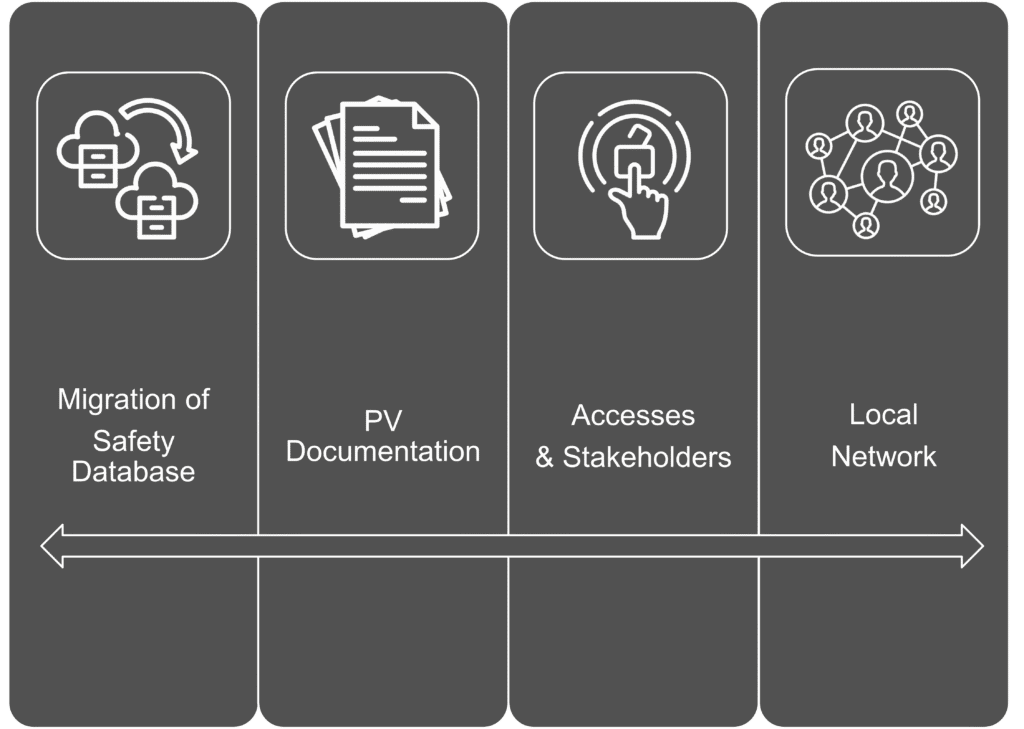
Migration of Safety Database
Migrating a safety database requires its own dedicated plan. Agreement is needed between the old and new providers on data format, transfer methods, and mapping of fields, particularly for non-E2B information. A controlled testing phase, involving sample cases, should be carried out before full migration begins. Any issues uncovered in this phase should be resolved in advance to avoid cascading errors.All deviations, decisions, and fixes during migration must be documented.
PV Documentation
All core PV documents must be transferred securely and completely. These include the PSMF, PSURs, RMPs, SDEAs, aRMMs, other routine operational documents like literature search strings, outputs, documented assessments, communications with authorities and supporting operational records such as KPIs, CAPAs, and SOP logs. Secure transfer methods should be used to protect sensitive information and comply with data protection regulations.
Access and Stakeholders
Access rights must be arranged early, especially for regulatory systems like the EMA portal or MHRA submission tools. Account creation or modifications may require lead time, particularly when multiple users or shared accounts are involved.
Stakeholder communication is also vital. All regulatory bodies, internal departments, and external partners should be informed of updated contact information and responsibilities. Temporary forwarding of communications and dual access can help capture messages sent to outdated addresses.
Local Network
Local handovers present their own set of challenges. Some countries require simple notifications, while others mandate notarised documents or formal approval letters. Planning for these variations helps avoid compliance gaps. Where appropriate, local transitions can be completed in stages. Each handover should be fully documented and include the status of ongoing tasks.
4. Post-Transfer
Post-transfer activities ensure the new system is functioning as intended. Teams should review legacy data, validate system outputs, and check alignment with obligations like PSUR schedules, RMP versions, or signal detection trackers.
Remaining tasks from the old system should be closed out, and access permissions should be finalised. Communication channels should be tested to confirm that all parties are reaching the correct contacts. The objective is not only to complete the transfer but to stabilise the system and prepare it for long-term use.
Final Thoughts
A pharmacovigilance system transfer is not just a technical process. It is a strategic change that influences how an organisation meets its compliance obligations and protects patient safety. When handled properly, it also provides an opportunity to streamline operations, improve data integrity, and enhance overall system performance.
The most effective transfers are those that are planned thoroughly, executed with discipline, and supported by experienced teams. Insuvia has worked with companies across the industry to guide them through every stage of this process.
If your organisation is preparing for a transfer, we can provide not only expert support but also checklist to keep the process on track. Fill the form below to get your copy.
Related news
-
 20 July, 2026 Pharmacovigilance Webinars
Webinar “Pharmacovigilance System Transfer: Ensuring Seamless Shift”
-
02 July, 2026 Pharmacovigilance Articles
How to manage pharmacovigilance effectively in compassionate use programs
-
21 July, 2021 Pharmacovigilance Articles
Integration of Client-Vendor Pharmacovigilance Systems